
Executive thesis: Tulum is repricing, not simply recovering
Tulum is not dead. The fantasy pricing is.
For the past two years, the easiest framing of Tulum real estate has been binary: either the market has collapsed, or it is on the verge of a comeback. Both narratives are too simple for an investor making a real decision.
The more useful interpretation is that Tulum is entering a price-discovery phase. The city’s development pipeline expanded dramatically during the boom; reported annual sales and absorption slowed afterward. The result is not that every property is cheap, nor that every resale is a bargain. It is that the buyer has more leverage to test a property against evidence rather than accept a brochure’s implied valuation. [1]
This matters because the next durable opportunities are unlikely to come from generic optimism. They will come from a more disciplined process: compare the right alternatives, separate asking prices from market value, price construction and legal risk explicitly, and demand a clear reason why a particular asset deserves capital today.
The data says the market needs price discovery
El Economista reported a 2026 InfoHabitat analysis—using information from Softec and Mexico’s Secretariat of Tourism—that describes a widening mismatch between construction, sales and absorption in Tulum. The reported figures are not transaction-price indices, and they do not predict a future price path. They do, however, show why a market that once rewarded speed and marketing now needs more selective underwriting. [1]
| Indicator | Earlier reported point | Later reported point | Calculated change | What it tells a buyer |
|---|---|---|---|---|
| Units in process | 1,466 in 2017 | 13,266 in 2023 | About 9.1× | The supply pipeline expanded rapidly. |
| Inventory for sale | 3,243 in 2019 | 6,340 in 2023 | About +95.5% | More visible choice can increase the value of careful comparison. |
| Annual sales | 3,487 in 2023 | 1,711 in 2025 | About −50.9% | A slower reported sales rate can lengthen the path from listing to transaction. |
| Monthly absorption per development | 1.4 in 2022 | 0.9 in 2025 | About −35.7% | The reported pace of unit placement weakened. |
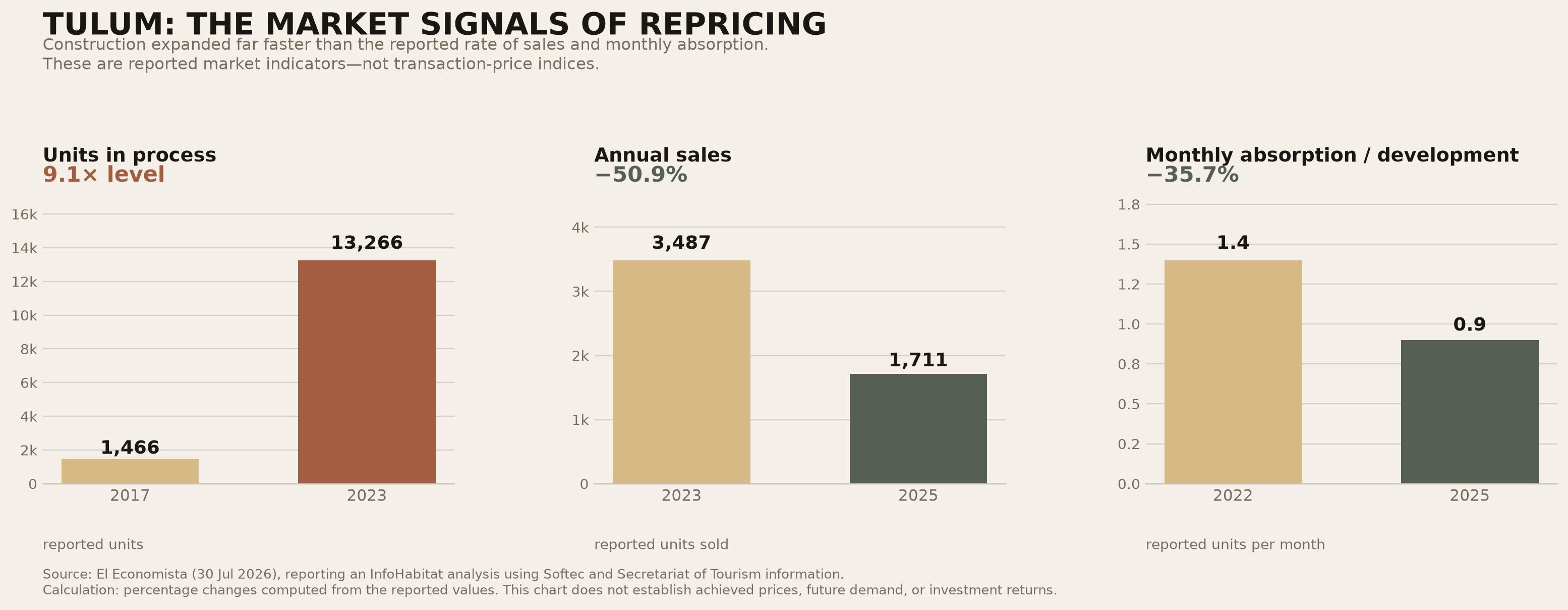
The appropriate conclusion is not “prices must fall by a fixed percentage” or “the market has bottomed.” Neither conclusion follows from these series. The appropriate conclusion is that the burden of proof has shifted. A seller, developer, broker or advisor should be able to show why a property remains competitive after accounting for the buyer’s alternatives, risk and carrying cost.
Expansión Obras reported a separate industry estimate of more than 10,000 resale units and a 32–35% decline in new-home sales since 2023, attributing both to 4S Real Estate. This should be read as an industry estimate, not combined mechanically with the InfoHabitat inventory series: the series may use different definitions, geographies and time windows. Its value is directional—it reinforces the case for treating supply and resale competition as a central diligence question. [2]
Repricing is not a recovery call
A repricing market is not a market where everything becomes investable. It is a market where the gap between an asking price and a defensible price becomes visible.
That distinction is crucial. A high-quality, completed home at an undisciplined price can remain a poor purchase. A conventional unit with a meaningful, verifiable discount to relevant alternatives can become worth serious attention. In both cases, the investment case depends on specific evidence: condition, location, condominium governance, fees, maintenance, legal status, liquidity, financing terms and the buyer’s own time horizon.
The result is a healthier question than “Will Tulum recover?”:
At today’s asking price, with today’s risks and today’s alternatives, is this specific property attractive?
That is the question buyers should be able to answer before they sign—not after the render becomes a building.
Why completed inventory deserves a fresh comparison
Historically, presales can offer a discount because the buyer accepts time, delivery and execution risk. That trade-off can still be rational when the developer, documentation, construction economics and delivery terms are credible.
But a completed resale deserves to be evaluated differently. It allows a buyer to inspect the actual unit, building, approach road, surrounding construction, maintenance, management, common areas and realised occupancy conditions. It also creates a clearer place to start a comparable analysis: the asset exists today.
| Buyer question | Completed resale: evidence available now | Presale: evidence that must be underwritten |
|---|---|---|
| What am I buying? | Unit, building and neighbourhood can be inspected. | Plans, specification, delivery scope and change rights must be checked. |
| What is the operational reality? | Fees, maintenance condition, management and occupancy can be investigated. | Operating assumptions are prospective and require independent challenge. |
| What is the execution risk? | Physical delivery risk is largely resolved; legal and condition risk remain. | Delivery, financing, contractor, permit and specification risk require explicit analysis. |
| What should justify the price? | Dated alternatives, unit-specific condition and evidence of liquidity. | A clear risk-adjusted advantage over completed alternatives. |
The point is not that every resale will outperform every presale. It is that presale should no longer be treated as the default product simply because it comes with a payment plan and a polished deck. It should earn the buyer’s preference through a risk-adjusted case.
The Xalet observation: asking price is not market value
Public listing pages can show how wide the difference between asking prices can be even inside one development. As of 9 September 2026, three separate public Xalet Tulum advertisements showed the following price-and-area observations.
| Public listing observation | Advertised price | Stated area | Implied asking price per m² | Why it cannot be treated as a valuation |
|---|---|---|---|---|
| One-bedroom, furnished | USD 265,000 | 64.9 m² in listing text | About USD 4,083 | Asking price; condition, unit position and availability require verification. |
| Two-bedroom listing | USD 436,800 | 105 m² | About USD 4,160 | Asking price; it does not demonstrate an achieved sale or equal terms. |
| Three-bedroom listing | USD 620,000 | 246 m² | About USD 2,520 | Larger unit; size, layout and other attributes materially differ. |
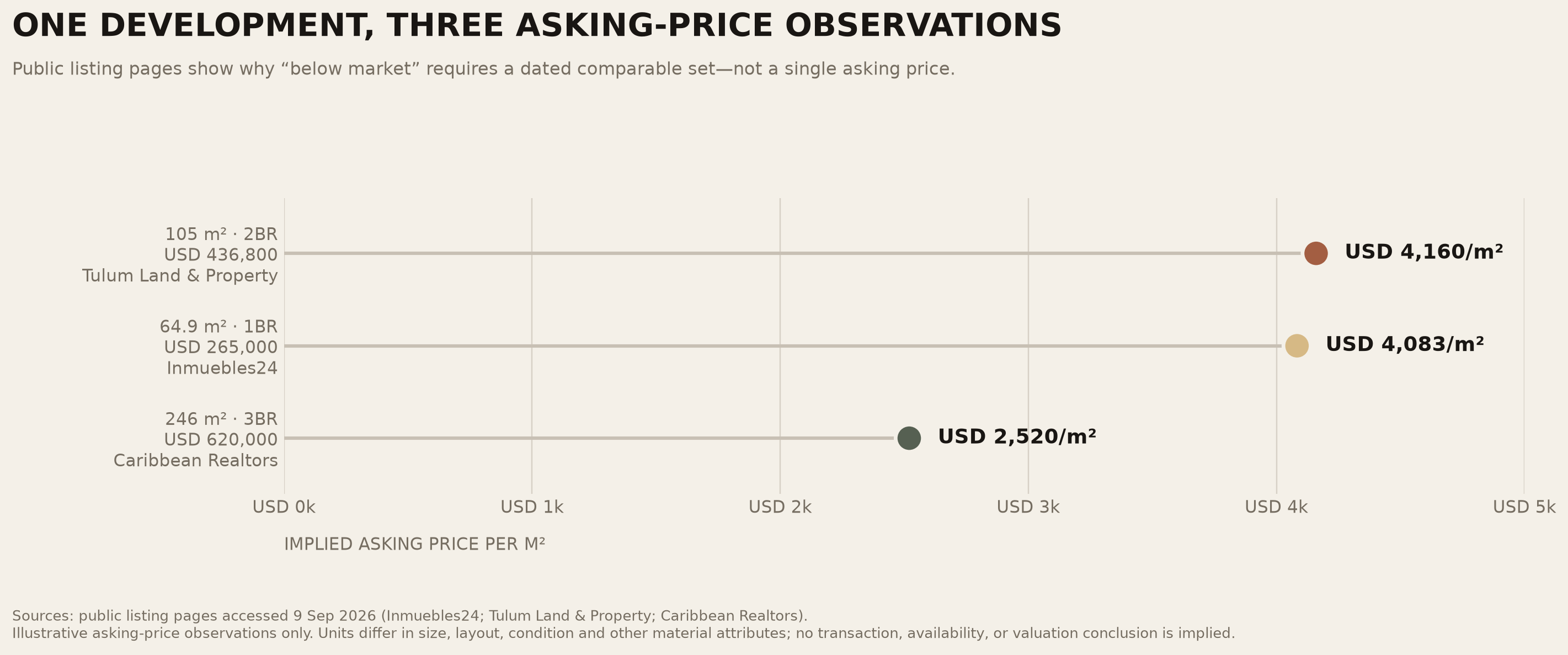
The chart is not evidence that any one listing is cheap, expensive or representative. It is evidence of something more important: a phrase such as “below market” is analytically empty unless the comparison set is disclosed.
Price per square metre is useful as an initial screen, but it is not a valuation. Floor level, outdoor space, furniture, orientation, condition, title, condominium economics, maintenance, view, delivery stage, seller motivation and financing terms can all matter. The buyer needs a dated comparison set and, where available, credible evidence of achieved transactions—not a single brochure or a broker’s assertion.
Certainty has become part of the price
Legal and planning risk cannot be treated as a footnote. In August 2026, Quintana Roo’s SEDETUS and the Municipality of Tulum issued a public warning concerning the specific Ocean Tulum project. Reporting on the official communication stated that the project lacked required permits and authorisations for commercialisation and was subject to judicial and administrative processes. This is a documented project-specific case, not a conclusion about all Tulum developments. [3]
The buyer lesson is broader and simple: verify before you pay. Quintana Roo’s public Registry of Property and Commerce portal provides property inquiry tools, real-estate alerts and routes to services such as a certificate of liens and registry-history certificate. These resources do not replace independent counsel, but they show that critical diligence should be documented—not outsourced to confidence. [4]
In a repricing market, certainty can justify a premium. A completed, documented asset with visible maintenance and a clean, reviewable evidence trail may deserve a different risk treatment from a cheaper-looking alternative whose documentation, delivery or future operating conditions cannot be substantiated.
From a property folder to an evidence ledger
The market’s information problem is not simply that data is scattered. It is that scattered data is often mistaken for analysis. A folder containing renders, a price sheet and a payment plan is storage. It is not a conclusion.
An evidence ledger turns material claims into reviewable work. It separates the seller’s representation from the buyer’s verification and records the date, source, limitation and unresolved question attached to each important item.
| Evidence field | Minimum buyer record | Decision use |
|---|---|---|
| Asset identity | Unit, title holder / seller representation, development, exact location and date observed | Prevents comparison of unlike assets. |
| Price and terms | Currency, price, inclusions, financing, fees, taxes and validity date | Separates headline price from all-in economics. |
| Comparable set | At least several dated alternatives, with size, condition and material differences disclosed | Tests whether “value” is demonstrated rather than declared. |
| Legal and planning | Registry, permits, condominium documents and attorney review status | Makes legal uncertainty visible before commitment. |
| Physical condition | Inspection notes, maintenance condition, amenities and surrounding works | Tests the real asset rather than the render. |
| Operating evidence | HOA, utilities, management terms, documented rental history where relevant | Challenges unsupported operating assumptions. |
| Risk register | Open questions, owner, evidence deadline and decision consequence | Converts ambiguity into an action plan. |
The intermediary is changing too
Tulum’s next market phase will not be won by the loudest listing or the largest collection of developer decks. It will favour advisors who can turn fragmented information into a transparent decision process.
At Abraca Dabra Tulum, EstateWave is designed as a market-intelligence workflow for that purpose. It records and normalises dated property information—asking price, area, price per square metre, listing stage, update history and supporting documents—so that the buyer’s shortlist can be compared consistently. It does not create a universal market value, and it cannot replace legal, technical, tax or valuation professionals. Its role is narrower and more useful: make the evidence, assumptions and gaps visible.
That is a meaningful advantage only when it remains disciplined. The methodology has to be auditable. Comparisons must state their limits. Public listings must be labelled as asking prices. And a tool should make uncertainty easier to see—not easier to hide.
What selective opportunity looks like now
The opportunities most worth examining in a repricing phase tend to share a pattern. They are not necessarily glamorous. They are assets where the buyer can connect price to evidence, risk to documentation and negotiation to a credible alternative set.
An independent buyer should therefore favour a decision process over a headline. A strong shortlist can begin with the following sequence:
- Define the buyer’s use case and downside tolerance. Residence, second home and income-oriented use require different evidence and different liquidity assumptions.
- Screen the property against completed alternatives. Do not treat price per square metre as decisive; use it to identify questions.
- Map the risk-adjusted difference. If a presale is priced above a credible completed alternative, demand a documented reason for the premium.
- Verify legal and operational facts before negotiations harden. Do not allow a deadline to replace a diligence process.
- Negotiate from a documented evidence ledger. The goal is not to win an argument. It is to avoid paying for an assumption that cannot be verified.
A more mature Tulum is possible
Tulum still has global recognition, an unusual natural setting and infrastructure that can support long-term demand. Those attributes matter. They do not, however, make every condominium an investment at every price.
The correction is uncomfortable because it replaces automatic narratives with hard questions. But that is also its value. When sellers recognise the buyer’s alternatives, when developers compete on demonstrated execution rather than aspiration alone, and when advisors show their methodology, the market becomes easier to trust.
The most credible bullish case for Tulum is not that prices must immediately rise. It is that the market can become more legible: more transparent about supply, more selective about quality, more realistic about risk and more rigorous about value.
The next Tulum buyer should not be sold an opportunity. They should be shown the evidence for one.
Buyer action: test the asset, not the story
If you are evaluating Tulum, begin with an evidence-led shortlist. We work as an independent buyer’s representative: the objective is to compare the available market, surface material gaps and help you decide whether the evidence supports the asking price—not to maximise a developer sale.
Start with the Buyer Assessment to define your intended use, budget range, time horizon and tolerance for construction or legal complexity. Then we can build a comparison set around the actual decision you need to make.
Frequently asked questions
Is Tulum real estate recovering in 2026?
The evidence reviewed in this paper does not support a blanket recovery claim. It supports a selective price-discovery phase: reported sales and absorption weakened while inventory expanded, so buyer interest should be assessed property by property and price by price. 1 2
Are resale properties always better than presales in Tulum?
No. A completed resale can reduce inspection and delivery uncertainty, but every purchase still needs legal, physical, financial and comparable-price diligence. A presale should demonstrate a risk-adjusted advantage before it is preferred.
Can price per square metre prove a property is below market?
No. It is a screening metric, not a valuation. Size, layout, floor, condition, furnishings, outdoor space, maintenance, legal status, financing terms and actual transaction evidence can materially change comparability.
How should an international buyer begin verifying a Tulum property?
Start an evidence ledger: document price and terms, confirm the identity of the asset, build dated comparisons, inspect the physical condition, record operating costs, and seek independent legal and tax advice. Quintana Roo’s Registry of Property and Commerce portal provides public inquiry and registry-related services that can form part of that process. 4
Limitations and methodology
This paper is an editorial market-analysis framework, not an appraisal, offer recommendation, investment advice, legal advice or a prediction of prices, rents, returns or liquidity. Reported aggregate figures are cited to their publishers and may use methodologies or geographies that differ from one another. Public listings are dated asking-price observations, not confirmed sales. EstateWave is an internal evidence-structuring workflow; it is not a comprehensive public multiple-listing database.
Each buyer should obtain advice appropriate to their circumstances and verify documents, permissions, title, tax consequences, physical condition and transaction terms before proceeding.